Uptake of Water by Plants
By: SNEHA SINGH 30 Jan 2025 08:06:14
Uptake of Water by Plants
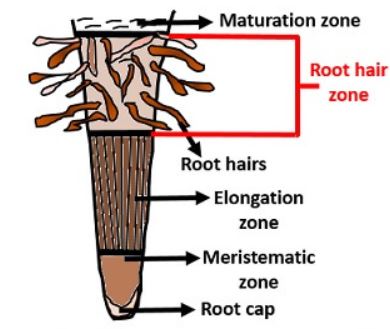
The process by which plants absorb water, primarily through their root hairs, is called water absorption. This is a vital process as water and minerals are essential for plant survival.
Key Points:
- In Lower Plants: The whole body acts as a water-absorbing organ.
- In Higher Plants: Only specific portions of roots, mainly root hairs, absorb water.
- Main Water Source: Plants absorb capillary water from the soil.
- Pathway to Leaves: The absorbed water moves through different tissues:
- Cortical cells → Endodermis (passage cells) → Pericycle cells → Xylem tubes → Leaves.
Functions of Absorbed Water:
- Maintains cell rigidity and turgidity.
- Essential for transpiration and photosynthesis.
- Aids in cell vitality and metabolic processes.
Types of Soil Water
The soil contains three types of water:
- Gravitational Water: Quickly drains out and is not available to plants.
- Hygroscopic Water: Forms a thin layer around soil particles and is not available for absorption.
- Capillary Water is trapped between soil particles and readily available for plant absorption.
Understanding Capillary Water:
- After rainfall, water seeps into the soil.
- A major portion drains out, but some water remains trapped in small spaces between soil particles.
- This water follows capillary action and is known as capillary water, the main source of water for plants.
Pathway of Water Absorption
Water absorbed by root hairs moves through different pathways to reach the xylem.
1. Apoplastic Pathway ("Apo" = Without Cytoplasm)
- Water moves through the cell walls and intercellular spaces.
- Fast pathway, but blocked at the Casparian strip in the endodermis.
- Water moves from the cell wall of one cell to another cell wall without crossing the plasma membrane.
2. Symplastic Pathway ("Sym" = Cytoplasm)
- Water moves through the cytoplasm via plasmodesmata (small channels connecting cells).
- No hindrance, water moves directly between cells.
- Regulated movement, allowing selective uptake of minerals.
- Click here for the picture <a hre="https://botanistsneha.in/assets/img/Gallery/Apoplast_symplast_20250201113123.png"> image </a>
Interaction Between Pathways:
- Water initially follows the apoplastic route but may enter the symplastic pathway at the endodermis due to the Casparian strip.
- The Casparian strip ensures that all water must pass through at least one plasma membrane, allowing regulation of water and mineral uptake.