Dr. William Roxburgh
By: SNEHA SINGH 09 Jun 2026 15:38:50
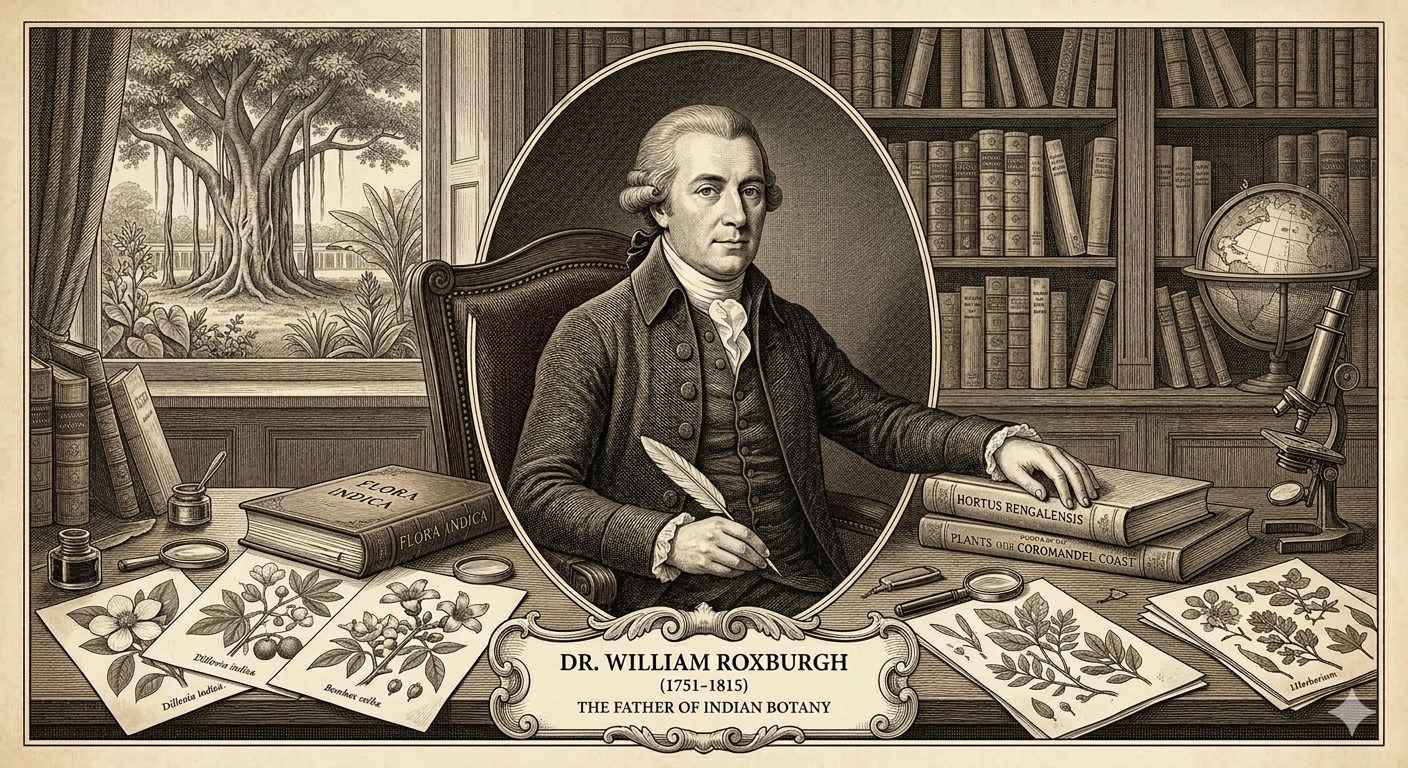
When exploring the foundations of Indian plant taxonomy, one figure anchors the post-Linnaean era: Dr. William Roxburgh (1751–1815). Universally celebrated as the "Father of Indian Botany," Roxburgh’s classical portrait represents far more than a historical likeness. It symbolizes a monumental transition where the rich, unexplored flora of the Indian subcontinent was first systematically cataloged using modern binomial nomenclature.
1. Deciphering the Era Behind the Frame
-
The Early Blueprint: Born in Scotland, Roxburgh trained in medicine and botany at the University of Edinburgh under Professor John Hope. He arrived in India in 1776, serving as an Assistant Surgeon in the Madras Medical Service.
-
The Proving Grounds: Stationed early in his career at Samalkot (Andhra Pradesh), Roxburgh established experimental grounds long before taking over the colonial capital's gardens.
-
Focus on Economic Botany: He conducted rigorous field trials on indigenous cash crops, including indigo, pepper, cardamoms, and sap-yielding trees. His precision in data collection laid the indispensable baseline for early tropical agricultural research.
2. Transforming the Royal Botanic Garden, Calcutta
In 1793, Roxburgh succeeded Colonel Robert Kyd to become the first salaried Superintendent of the Royal Botanic Garden at Shibpur, Calcutta (now celebrated as the Acharya Jagadish Chandra Bose Indian Botanic Garden, Howrah).
Under his operational leadership spanning twenty consecutive years, the garden evolved from a basic commercial nursery into an international epicenter for scientific taxonomy through two monumental milestones:
The Living Archive: He dramatically expanded the living collection, scaling it from a mere 300 specimens to more than 3,500 distinct plant species.
The Herbarium Foundation: He built the systematic plant repository that eventually matured into the globally recognized Central National Herbarium (CAL) of the Botanical Survey of India (BSI).
3. The Masterpieces: Roxburgh Icons & Flora Indica
Two massive, groundbreaking achievements define the scientific legacy captured in his portrait:
The Roxburgh Icons
Roxburgh took a revolutionary step by employing and training local Indian artists to execute structurally precise botanical illustrations. This cross-cultural collaboration produced a spectacular corpus of over 2,500 lifelike watercolor drawings. Because each plate was precisely numbered to match his scientific field notes, these "Roxburgh Icons" remain crucial type-specimen references for identifying Asian plants today.
Flora Indica and Hortus Bengalensis
His crowning manuscript, Flora Indica; or Descriptions of Indian Plants, stands as the first comprehensive account of Indian flora written in English using the Linnaean system. Though failing health forced him back to Europe in 1813, his close friend—the famous Serampore missionary Rev. Dr. William Carey—meticulously edited and posthumously published the texts, preserving his life's work for generations of botanists.
4. High-Yield Facts for Competitive Examinations
Keep these exact data points in mind for quick revision before sitting for competitive Botany recruitment or selection boards:
| Taxonomic Core Field | Historical Data Element | Exam Relevance |
| Moniker | "The Father of Indian Botany" / "Linnaeus of India" | A frequent matching-pair favorite in State PSC exams. |
| Eponymous Genus | Genus Roxburghia (Family: Stemonaceae) | Named in his honor by the Swedish botanist Jonas Dryander. |
| Pre-Departure Registry | Hortus Bengalensis (1814) | A complete catalog of 1,510 species actively growing under his care in Calcutta. |
| Interdisciplinary Work | Pioneer of Tropical Meteorology | Kept precise daily barometric and temperature logs three times a day in India. |