Enzyme
By: SNEHA SINGH 02 Feb 2025 16:48:27
Enzymes
1. General Properties of Enzymes
- Biological Catalysts – Speed up reactions without being consumed.
- Highly Specific – Act on specific substrates.
- Work Under Mild Conditions – Function at physiological pH and temperature.
- Regulated Activity – Can be activated or inhibited.
- Lower Activation Energy – Facilitate reactions by stabilizing the transition state.
2. Classification of Enzymes (IUB System)
- Oxidoreductases – Catalyze oxidation-reduction reactions (e.g., dehydrogenases).
- Transferases – Transfer functional groups (e.g., kinases).
- Hydrolases – Catalyze hydrolysis reactions (e.g., lipase, protease).
- Lyases – Add or remove groups without hydrolysis (e.g., decarboxylases).
- Isomerases – Catalyze isomerization (e.g., racemases).
- Ligases (Synthetases) – Join molecules using ATP (e.g., DNA ligase).
3. Mechanism of Enzyme Action
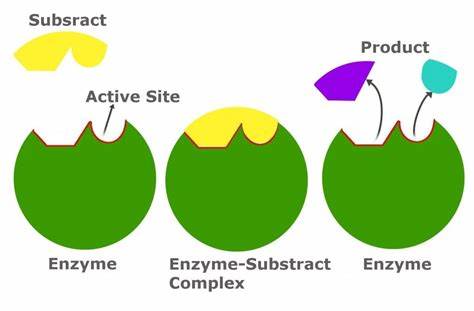
- Step 1: Substrate Binding – Forms enzyme-substrate (ES) complex.
- Step 2: Catalysis – Conversion of substrate into product.
- Step 3: Product Release – Enzyme returns to original state.
- Models of Binding:
- Lock and Key Model – Exact fit between enzyme & substrate.
- Induced Fit Model – Enzyme changes shape for substrate binding.
4. Michaelis-Menten Equation & Plot
- Describes the enzyme kinetics of single-substrate reactions.
- Equation: v=Vmax?[S]Km+[S]v = \frac{V_{\max} [S]}{K_m + [S]}v=Km?+[S]Vmax?[S]? Where:
- vvv = reaction velocity
- Vmax?V_{\max}Vmax? = maximum velocity
- [S][S][S] = substrate concentration
- KmK_mKm? = Michaelis constant (substrate concentration at ½ Vmax?V_{\max}Vmax?)
- Plot: Hyperbolic curve showing the relationship between vvv and [S][S][S].
5. Lineweaver-Burk Equation & Plot
- Double reciprocal form of Michaelis-Menten equation: 1v=KmVmax?[S]+1Vmax?\frac{1}{v} = \frac{K_m}{V_{\max} [S]} + \frac{1}{V_{\max}}v1?=Vmax?[S]Km??+Vmax?1?
- Plot: Straight-line graph (inverse of velocity vs. inverse of substrate).
- X-axis intercept: −1Km-\frac{1}{K_m}−Km?1?
- Y-axis intercept: 1Vmax?\frac{1}{V_{\max}}Vmax?1?
- Slope: KmVmax?\frac{K_m}{V_{\max}}Vmax?Km??
6. Introduction to Allosteric Enzymes
- Regulated by Effectors – Small molecules bind at sites other than the active site.
- Show Sigmoidal Kinetics (not hyperbolic like Michaelis-Menten enzymes).
- Types of Effectors:
- Activators – Increase enzyme activity.
- Inhibitors – Decrease enzyme activity.
- Example: Aspartate transcarbamoylase (ATCase).